
Detailed Guide To Barley Straw
A Natural Solution for Algae Control
Barley Straw offers an environmentally friendly and cost-effective approach to managing algae growth in various water bodies. This method of algae control has been successfully implemented in multiple Australian states and internationally.
What Are Algae?
Algae are photosynthetic aquatic organisms that are found in both freshwater and seawater. Algae are distinct from plants in several ways. They do not have proper stems, leaves, roots or a vascular system to circulate water and nutrients. They can be largely categorised into microscopic algae (a single cell) and macroscopic algae (multicellular, filamentous and/or colonial).
How It Works
Barley straw improves water quality through two primary mechanisms:
-
Nutrient Stripping: As it decomposes, barley straw utilises available nitrogen and phosphorus, reducing nutrients that promote algae growth.
-
Release of Inhibitory Compounds: Decomposing barley straw releases substances that inhibit algal growth.
Barley Straw through the Ages
Use of barley straw to suppress algae growth dates back to the Middle Ages, when countries started to experience cyanobacteria outbreaks in drinking water supplies. People started drinking liquor made from barley rotted in water because the alcohol was sufficient to kill pathogenic bacteria. In 1980, a farmer noticed that an accidental addition of rotting straw reduced algae growth the following year. Since then, barley straw’s ability to control algae has been well-studied and documented. Decomposing barley straw in well aerated water releases compounds that inhibit algal growth. It has been shown that barley straw is active against a range of algae including unicellular and filamentous forms.

Effectiveness & Application
Decomposition of Barley Straw is temperature dependent:
- At water temperatures below 10°C, straw becomes active in 6-8 weeks.
- Above 20°C, effectiveness is achieved in 1-2 weeks
Algae Response:
- Small, unicellular algae typically disappear within 6-8 weeks of application.
- Larger filamentous algae can survive for long periods and may not be controlled adequately if the straw is added too late in the growing season when the algal growth is dense.
- Research has shown that straw inhibits the growth by 20-40% on average with greatest inhibition (approx. 70%) occurring in straw allowed to rot for six months.
Recommended Application:
- Apply in early spring, before water conditions favour algae growth or before algal growth begins.
- A single application of straw may last several (4-6) months
- Anti-algae effect is only productive if the straw is rotting in well aerated (aerobic) conditions.
Best Practices
- Aeration: Ensure proper water movement to prevent anaerobic conditions
- Turbid Waters: Double the recommended quantity in muddy or highly turbid waters
- Placement: Distribute straw evenly, focusing on areas with water inflow and maximum wind exposure
- Avoid application during prolonged hot weather in waters with dense algal blooms to prevent deoxygenation
- Straw is more effective in preventing algal growth rather than eliminating existing blooms
- For filamentous algae, consider integrated control methods such as raking or herbicide use in combination with barley straw
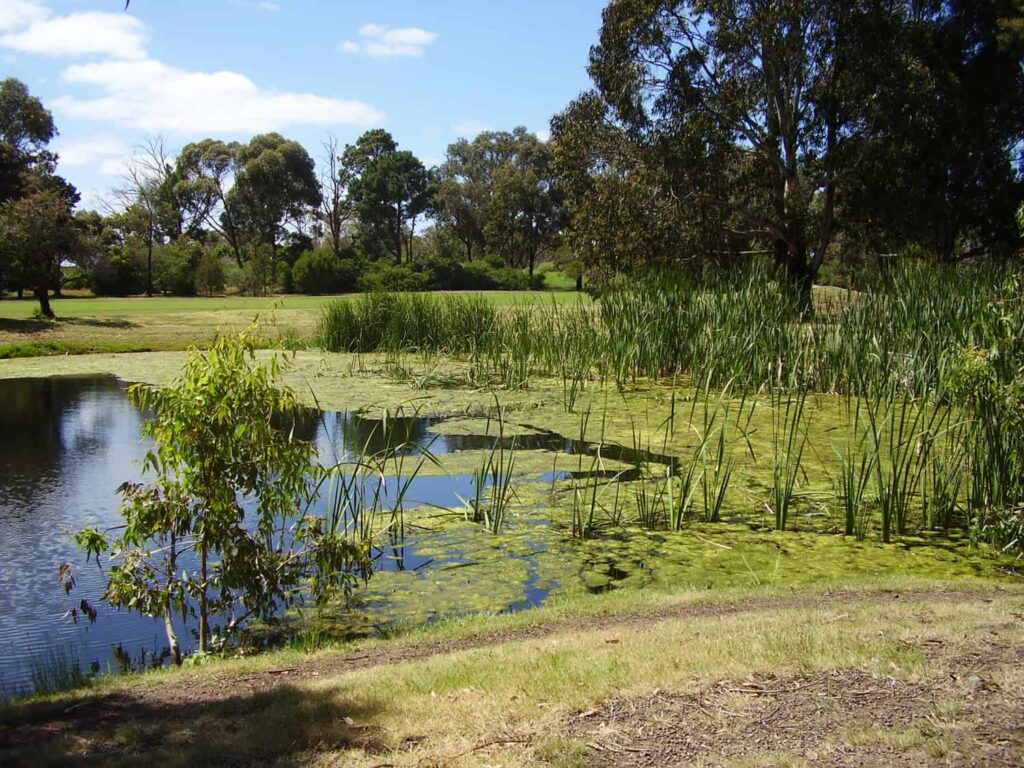
Use of Barley Straw to Manage Algae
Both in Australia & Internationally
- Barley straw has been successfully used in Central Queensland to control algae in sewage tertiary ponds
- Woolgoolga Water Reclamation Park in Coffs Harbour NSW has accepted the placement of barley straw mesh bags as a beneficial method of containing algal growth in waterways and catchment tanks
- In Victoria, barley straw is listed as a treatment option for blue-green algae in farm dams and farm storages by Agriculture Victoria
- Barley straw is recommended by the Western Australia Department of Primary Industries and Regional Development for the management of blue-green algae on farms
- Barley straw is used in many reservoirs and dams in the United Kingdom with positive results for algae control
- The Aquatic Weeds Research Unit (AWRU) at Long Ashton Research Station has records of reports detailing the management of algae using barley straw in Canada, Ireland, South Africa, Sweden and the USA.